We counted what gets posted by the pottery accounts that actually sell out, not the ones with the biggest followings. Nine formats kept coming back. The potter's face was in almost none of them.
You get all nine, with the shot list written out and the caption cut down to three blanks.
$9 one payment, instant access
$9 one time · nothing on camera, ever · fourteen-day guarantee
The counting
You have already spent thousands on this.
The kiln. The wheel. The shelving, the wiring, the bags of clay stacked under the bench. Somewhere between five and twelve thousand dollars, depending on whether you bought new and whether the electrician was kind. Nobody spends that on a whim. You are not dabbling.
A potter put it plainly, and it is the highest-voted thing anybody said in the six and a half thousand posts we read:
Most obvious thought is that it's an extremely expensive art hobby and so there is a strong desire to offset that cost.r/Pottery · 772 upvotes
And then you unload a full kiln of work you are genuinely proud of, photograph it on the kitchen counter, freeze on the price, write a caption that feels fake, post it, and get three hundred views.
Then somebody in the comments tells you to post more.
We went and counted, because the advice never seemed to match the results. Across the pottery accounts where the shop actually empties, not the ones with the most followers, the ones that sell out in minutes, the same nine post formats kept showing up. And the potter's face was in almost none of them.
That is the whole finding. It took a long time to accept how simple it was.
Here is what nobody told you. Your posts are not failing because the algorithm has it in for you. They are failing because every single post you make does the same job.
There are only three jobs a post can do. Earn attention. Create wanting. Ask for the sale.
Almost every potter posts from the first one and only the first one. Throwing videos. Glaze pours. Process reels. Beautiful, watchable, genuinely lovely work. And completely ambient. People watch, feel something pleasant, and scroll on. Nothing ever turns the watching into wanting, and nothing ever asks.
Which is exactly why you can say, as one potter did:
Posts would get hundreds of likes and get thousands of views, but that's it. I think I sold one or two items over the last couple of years, and they were to people I personally know.
You have been doing one third of the job. Perfectly. For years.
Now the part that should annoy you. The shelf that actually sells, the drop announcement, the slow pan across the finished shelf, the packing shot, is the least personality-dependent shelf of the three. It needs your work and a date. It does not need your face, your voice, or a single word of small talk.
So when you were told to get on camera, get comfortable, show your personality, build your brand, you were being coached to optimise the one shelf that was already working for you. Every piece of that advice was written by people who like being on camera, for people who like being on camera. You were handed a playbook for a different person and then quietly blamed for not running it well.
And underneath the feeling there is a practical problem nobody ever costed:
A real social media presence requires constant content creation. And I don't have time to create content, because I'm too busy creating ceramics!r/Pottery
The playbook assumed making content was part of the job. It was never supposed to be your job. You already have one, and it happens at the wheel.
It was never you.
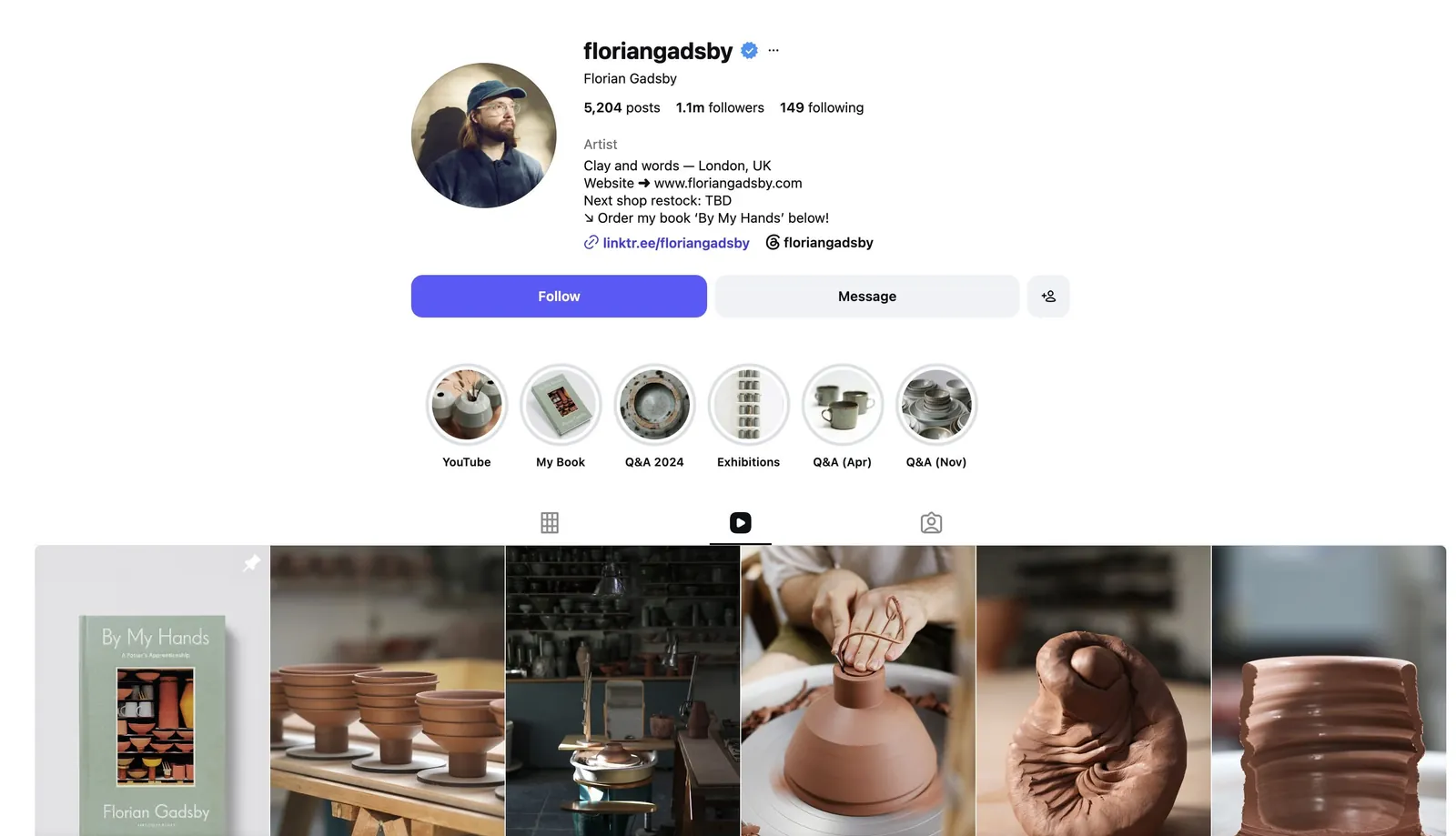
You can check all of this without buying anything. Florian Gadsby has over 1.1 million followers on Instagram and 1.8 million on TikTok with his body almost entirely out of shot, and he publishes his own numbers: 250 to 450 pots per restock, around 20,000 visitors, sold out in two to five minutes. Kara Leigh Ford, 100,000 followers, published this:
Instagram showed my most recent post to less than 0.01% of my audience. Just 73 people engaged out of 100,000.Kara Leigh Ford, potter, 100k followers
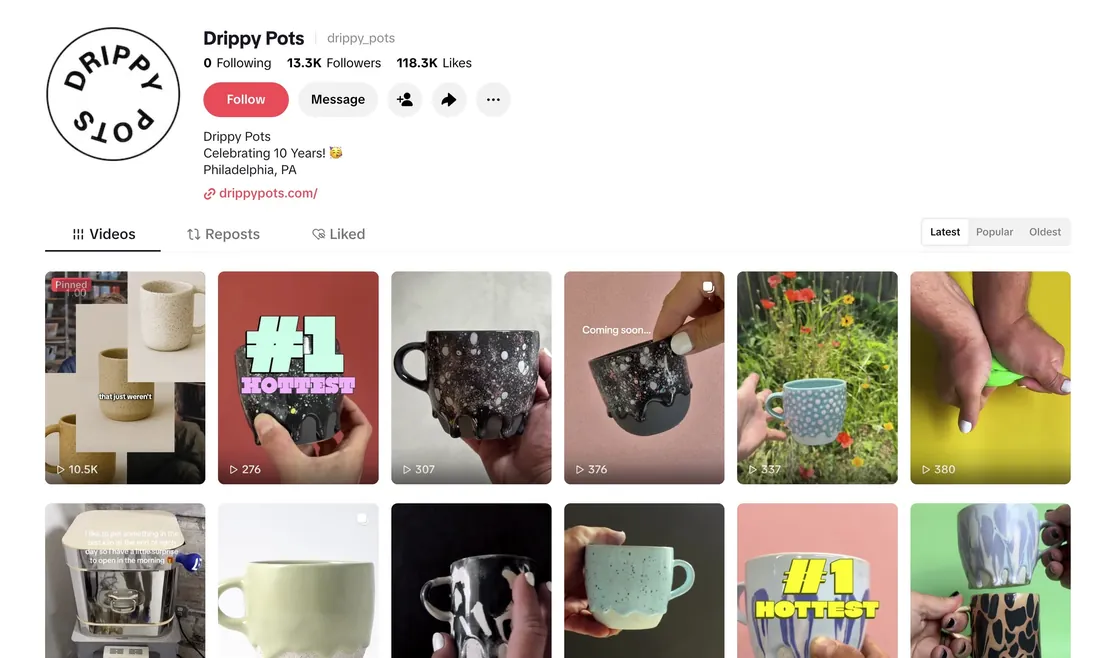
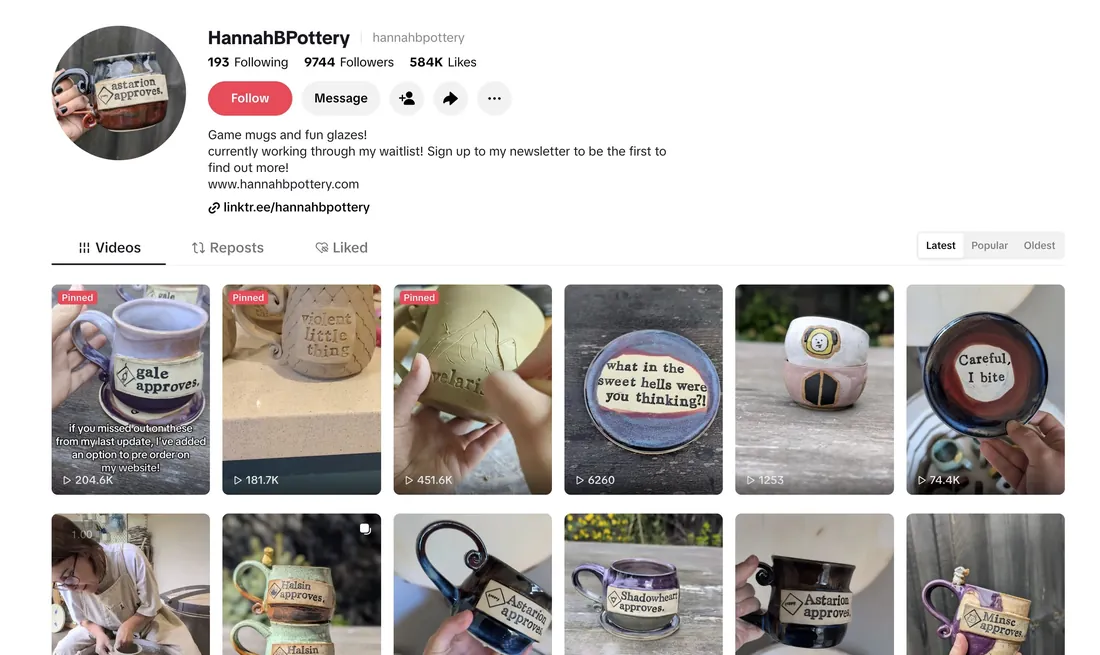
Meanwhile @drippy_pots sells weekly with no human in frame at all, and @hannahbpottery pulls 600,000 plus plays per video posting objects on a surface.
Follower count is not the machine. Format is.
The No-Face Pottery Sales Switch is all nine formats, written out. Each one comes with what it is, why it works, three live examples you can click and inspect yourself, the exact shot list, and a caption frame with three blanks so you are never staring at a cursor. Underneath that is a one-page sorter that shows you which shelf you have been posting from, a phone-only filming setup that keeps your hands in frame and your face out of it, and your first seven posts written out in order using pieces that are already sitting on your shelf right now.
Not a plan to fill in. A list to execute.
In the first seven days you will post three pieces you already have, in three formats you have never used, and you will know inside a week which one your people actually respond to.
It is nine dollars. Less than a bag of clay. Less than the wire you cut it with.
Every kiln load you unload without a plan is another shelf of work that nobody sees. There is no timer on this page and no fake deadline. There is just the next kiln, and whether it goes the same way as the last one.
If posting is the part you actually like, you do not need this.
The mechanism
Walk into any shop that actually sells things and three separate jobs are happening at once.
Shelf 1
The window. It stops someone on the pavement.
Throwing, glazing, the kiln coming open. The highest-reach shelf in every account we counted. Almost certainly the only one you post from.
Shelf 2
The display table. They pick it up and turn it over.
The two-parter, the failure post, the running series. Almost nobody posts these, which is why the watching never turns into wanting.
Shelf 3
The counter. There is a price on it and a way to pay.
The drop announcement, the shelf pan, the packing shot. Lowest views of the three. And in every account we counted, the post that shows up right before the shop empties.
No shopkeeper confuses the three. Nobody puts the till in the window and then wonders why the day's takings are nil.
A feed works the same way, and here is the part nobody says out loud: a post can only do one of those three jobs at a time.
You have been stocking the window. Beautifully, for years. And a shop that is only a window is not a shop, it is a display case.
Now the part that should annoy you.
The shelf that does the selling is the one that needs you least. A drop announcement is a date, a number and a link. A shelf pan is one slow move across finished work. A packing shot is your hands, some tape and a box. Not one of the three asks you to speak, appear, perform, or be interesting.
Every hour you spent getting braver on camera was spent improving the one shelf that was already working.
Fourteen-day guarantee. Keep everything either way.
How it goes
Nothing new gets made. You start with what is already on your shelf.
Step 1
Open the sorting page and run your last ten posts through it. It takes about four minutes. Nearly everyone lands on the first shelf, the watching shelf, and seeing it laid out is the moment the whole thing clicks. You are not going to find out that you are boring or bad at this. You are going to find out that you have been doing one job out of three.
Step 2
No new making required, and nothing needs to be perfect. Seconds count. The mug you think is a bit wonky counts. Run what is physically in front of you through the shelf audit, and it will tell you which pieces belong in which format. By the end of this step you have three pieces chosen, three formats assigned, and a written order to post them in.
Step 3
The setup page tells you where to stand, where to put the phone, and how to keep your hands in the frame and your face out of it. Nothing gets bought and nothing gets installed. Each format has its own shot list, so you are following instructions rather than improvising, and most clips take under four minutes to shoot on the corner of the bench you already work at.
Step 4
This is the step almost nobody does, and it is the one that sells. You announce a date, a count and a link, in the exact words the frame gives you. The launch checklist shows you the smallest possible way to take payment, no shop build, no website, no brand. Then you watch which of the three formats your people responded to, and you make more of that one.
Why this one is different
Not a single format in here needs your face, your voice, or you talking to a phone. Your hands appear in some of them. That is the maximum ask, and it is optional. The formats that do the actual selling, the drop announcement and the shelf pan and the packing shot, need your work and a date. Nobody watching will notice, because the potters you already follow work the same way.
The 2am editing sessions stop. You open the phone knowing exactly what to film today, and filming takes four minutes because the shot list is already written. A caption takes ninety seconds because you fill in three blanks instead of staring at a cursor. Making stops competing with marketing for the same evening. The wheel gets your good hours back, which is where you wanted them in the first place.
Every format came out of counting real pottery posts that moved real work. You get the live links, so you can open each example, look at it, and decide for yourself whether it is worth doing. Nothing is hosted here or re-uploaded. You click through and see the actual post with the actual numbers. If a format does not suit your work, you will know within about ten seconds.
This is not a mindset shift or a calendar you have to maintain. It tells you what job each post has to do, which means you can build your own posts from your own kiln loads forever, instead of running out of somebody else's ideas by week three. Skip a week and nothing breaks. Come back on a Tuesday with two mugs and a phone, and it still works.
What's included
Six pieces. All of it usable tonight, with pots you have already fired.
Actual screens from inside it. Nothing here is a mockup.

Included 01
The core of the whole thing. Nine post formats, sorted onto three shelves by the job they do: Watch, Want, Buy. Each one arrives as a card with what it is, why it works, three real live examples with links, the saves-per-view we observed, the exact shot list, and a caption frame with three blanks. Work through the cards in order and you never have to invent a post again.

Included 02
One frame for every format, nine in total, each with three blanks. You fill in what you made, one true detail about it, and what happens next. That is the entire writing task. No blank page, no trying to sound like an advert, no phrases that make you cringe when you read them back the next morning. Ninety seconds per caption, and it still sounds like you wrote it.

Included 03
One page. Phone only. Where to stand, where to prop the phone, which light in your space to use and which to avoid, and how to keep your hands in the frame with your face reliably out of it. Nothing to buy, nothing to install, no tripod required, no ring light. Set it up once at the corner of your bench and every future shoot starts from the same spot.

Included 04
A dated sequence built from pieces you have already made. Day one through day seven, each one naming the format, the piece and the shot. This is not a calendar you have to sit down and fill in, it is a list you execute. By day seven you will have posted from all three shelves, including the one that asks, and you will have data instead of a theory.

Included 05
The one-page diagnostic. Run your last ten posts through it and it shows you which shelf you have been posting from. Nearly everyone lands on the watching shelf, which is why the views arrive and the sales do not. It takes four minutes, it explains years of results in one look, and it is the reason the rest of this makes immediate sense.

Included 06
Every example in the product links out to the real post, so you can go and look at it live with the real numbers attached. Nothing is re-uploaded or screenshotted here. Twenty-seven examples across the nine formats, from accounts between nine thousand and over a million followers, so you can see the same format working at your size and not only at influencer scale.
All six pieces plus the five bonuses below.
Included free
Every one of these exists because a potter said the exact sentence underneath it.

Bonus 01
Kills: "I have nothing worth posting"A one-page sorter that turns whatever is on your shelf right now into a full week of posts, including the seconds, the repeats, and the pieces you have privately written off as failures.

Bonus 02
Kills: "what if someone actually comments?"Nine short replies for the nine things people say. How much, do you ship, is it food safe, can you make one in blue. Written so you never freeze again.

Bonus 03
Kills: "it feels so phoney"The exact phrases that make a maker's caption read like an advert, each with the plain human version underneath. Run any caption through it in twenty seconds before you post.

Bonus 04
Kills: "this cannot work without being on camera"The audited list. Who they are, how big they are, what they sell, and a link to check every single claim yourself. Anchored by Florian Gadsby at 1.14 million followers.

Bonus 05
Kills: "what do I do when I have something to sell?"The smallest possible way to take money. The link, the list, the announcement post. No shop build, no website, no brand identity, no waiting.
Proof
We have no customer testimonials to show you, because this has not launched yet and we are not going to invent any. What we have instead is the evidence the whole thing was built from, and all of it is public.
Every product you have been sold before came with a wall of five-star cards, and it did not make a single one of them work for you. Read the empty space here as the same thing the rest of this page is doing: telling you only what we can actually show you.
Florian Gadsby
1.1m Instagram · 1.8M TikTok
Scroll his grid. Clay, hands, the wheel, the kiln. His body is almost entirely out of shot in the work itself. He publishes his own numbers: 250 to 450 pots per restock, around 20,000 visitors, sold out in two to five minutes.
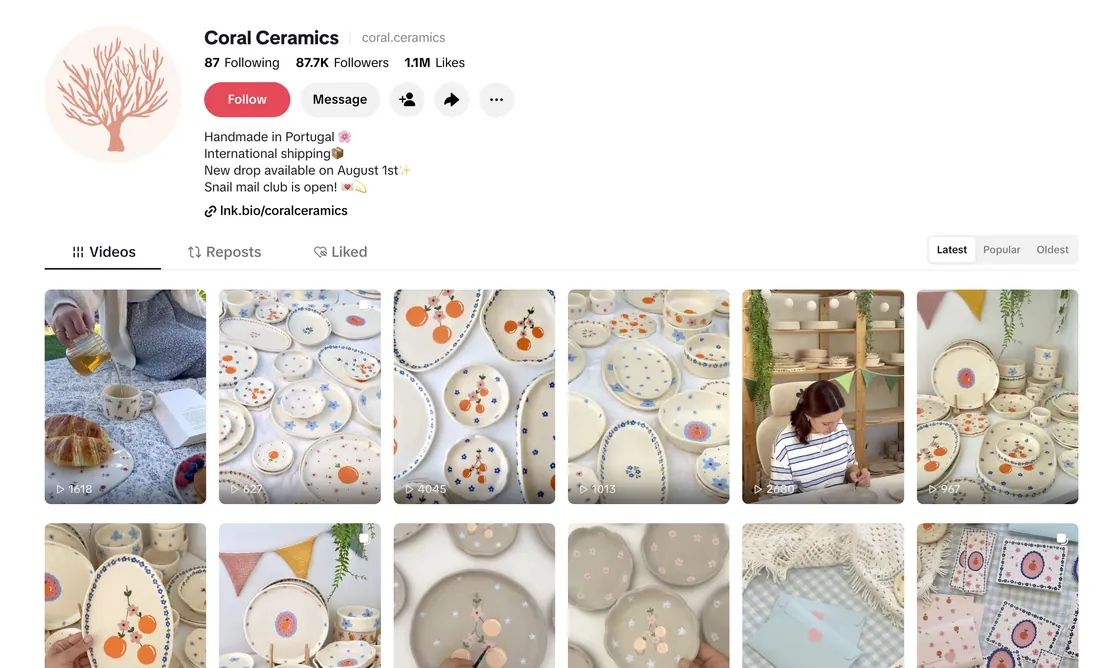
@coral.ceramics
87.7K TikTok · 1.1M likes
Painted plates, shot flat on the table or held in one hand. The bio does the selling: handmade in Portugal, international shipping, and a dated drop announced in the profile.
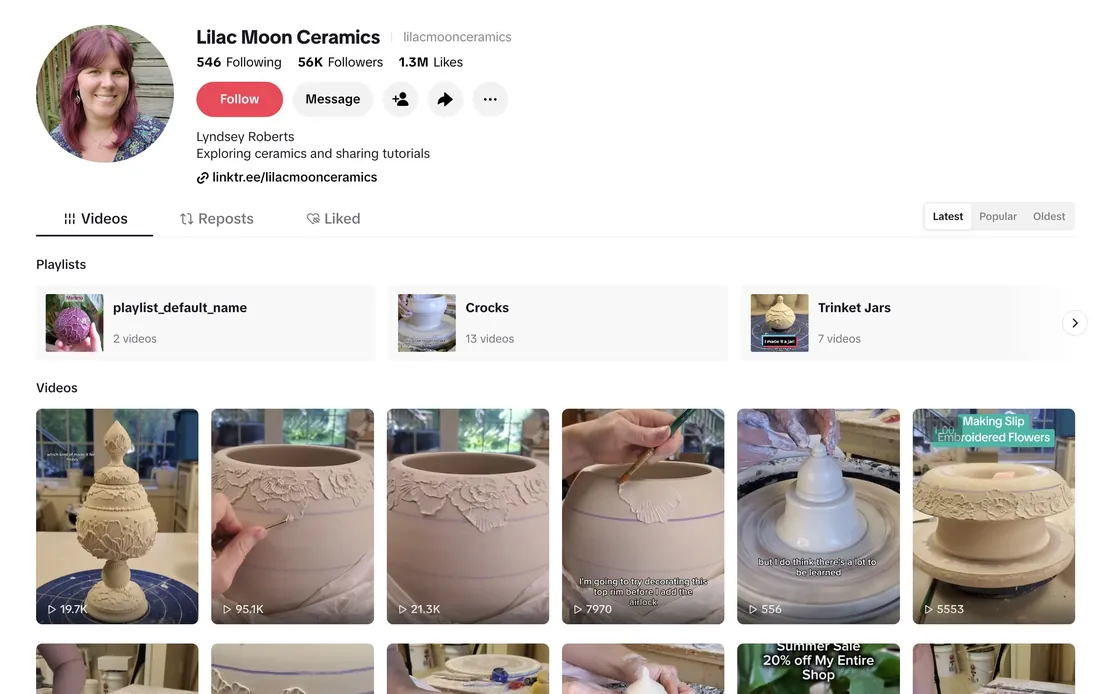
@lilacmoonceramics
56K TikTok · 1.3M likes
Overhead hands and a brush, the same framing on almost every post. 1.3 million likes on a body of work where the camera never once turns around.
@drippy_pots
13.3K TikTok · 118.3K likes
Mugs against flat colour, held up by one hand and nothing else. Thirteen thousand followers running weekly passcode drops. No face anywhere on the account.
@hannahbpottery
9,744 TikTok · 584K likes
Stamped mugs held up to the camera, 584,000 likes on under ten thousand followers, and a pinned post at 451,600 plays. She sells from a waitlist and a newsletter.
Read the two ends of that list again
1.1m followers · 9,744 followers
Gadsby sells out in minutes. Hannah runs a waitlist on under ten thousand. Between them sit three accounts at every size in between, all selling, and not one of them built on showing a face. Followers are not the machine. Format is.
Before you decide
You have stayed away from the hundred-post packs because they come off as cookie cutter, and you were right to. Here is the test you were already applying without writing it down. Use it on us too.
01
A list of ideas runs out in a fortnight. A job never runs out, because you apply it to whatever came out of the kiln this week.
02
If it needs new work, new props or new gear before you can start, it is not a system. It is homework.
03
A screenshot of a result is not a result. If a product cannot show you the post it is describing, go and look elsewhere.
04
If it falls apart the first time you skip three days, it was a calendar, not a system. Real weeks have kiln failures and day jobs in them.
05
If the answer is anywhere near yes, the answer is no. You already have a job you like. This is not supposed to replace it with a second one.
| 01 | 02 | 03 | 04 | 05 | |
|---|---|---|---|---|---|
| A hundred captions in a folder | no | yes | no | no | no |
| "Just post four times a week" | no | yes | no | no | no |
| Getting comfortable on camera | no | yes | yes | no | no |
| The No-Face Pottery Sales Switch | yes | yes | yes | yes | yes |
Notice that every option passes 02. That one is easy and everybody clears it, which is exactly why it is the criterion you keep getting sold on. The four that matter are the ones nothing else on that list manages.
Fourteen-day guarantee. Keep everything either way.
Get it
$9 today. One payment. Instant access.
And there is no crossed-out number above it, because there was never a higher one to cross out. Every other page in this niche does the crossed-out thing and you stopped believing it years ago. $9 is simply what it costs. It is priced there because this has not launched yet, which means you would be taking the first risk on it, and the fastest way for us to find out whether it works is for a few hundred potters to actually use it rather than admire it.
Who is behind this
There is no personality attached to this, and that is on purpose.
A product that tells you that you never have to be on camera cannot be fronted by somebody selling their own face. It would contradict itself in the first line.
So here is the honest version. We are publishers, not potters. We are not better at the wheel than you are and we would not pretend to be. What we did was count.
We went through pottery accounts that actually sell out, the ones where the shop empties in minutes rather than the ones with the biggest followings, and we logged what they post. Nine formats kept appearing. The potter's face was in almost none of them.
That is the entire claim. Every example links out, so you never have to take our word for any of it. Go and check.
We are not going to ask you to commit to thirty days, or sixty, or ninety. You have been given long-horizon advice before and it is part of why you are tired.
So here is the deal instead.
Get the switch today. Run the sorting page tonight, it takes four minutes. Pick three pieces off your shelf. Post them in three formats you have never used, in the order the first-seven-posts list gives you.
That is one week. One kiln load's worth of work you have already made. Then you have a second week on top, just to decide.
If at any point in those fourteen days you do not feel the difference, and by difference we mean the specific relief of opening your phone and knowing exactly what to post without dreading it, then email us and we will refund every cent. No form to fill in, no reason to give, no back and forth.
Keep everything. The nine formats, the caption frames, all five bonuses. Nothing gets locked or clawed back.
It is nine dollars against a kiln you have already paid for. The only thing you can lose here is another two weeks of posting the way you have been.
Questions
Fourteen-day guarantee. Keep everything either way.
P.S.
There is no timer on this page.
Nothing here expires, there is no countdown, and the price is not going up at midnight. A timer would be a lie and you would know it was a lie the moment you saw it.
But the kiln does not wait.
You have a load in there now, or one going in this week. And when it comes out you will do what you did last time. Photograph it badly on the kitchen counter. Freeze on the price. Write something that feels fake. Post it. Watch it reach three hundred people, none of whom will buy anything.
That is the actual cost. Not nine dollars. Another shelf of work that nobody sees.
You did not spend thousands on a kiln to make gifts. Somewhere on that shelf behind you is a month of firings nobody has paid you for.
And the thing you actually want is not a following. It is one order, from a name you do not recognise, for a pot you already made. The first sale in two years that was not somebody who already knew you.
That is on the other side of one post you have never made.
Fourteen days. If you do not feel the difference, you pay nothing and you keep everything.